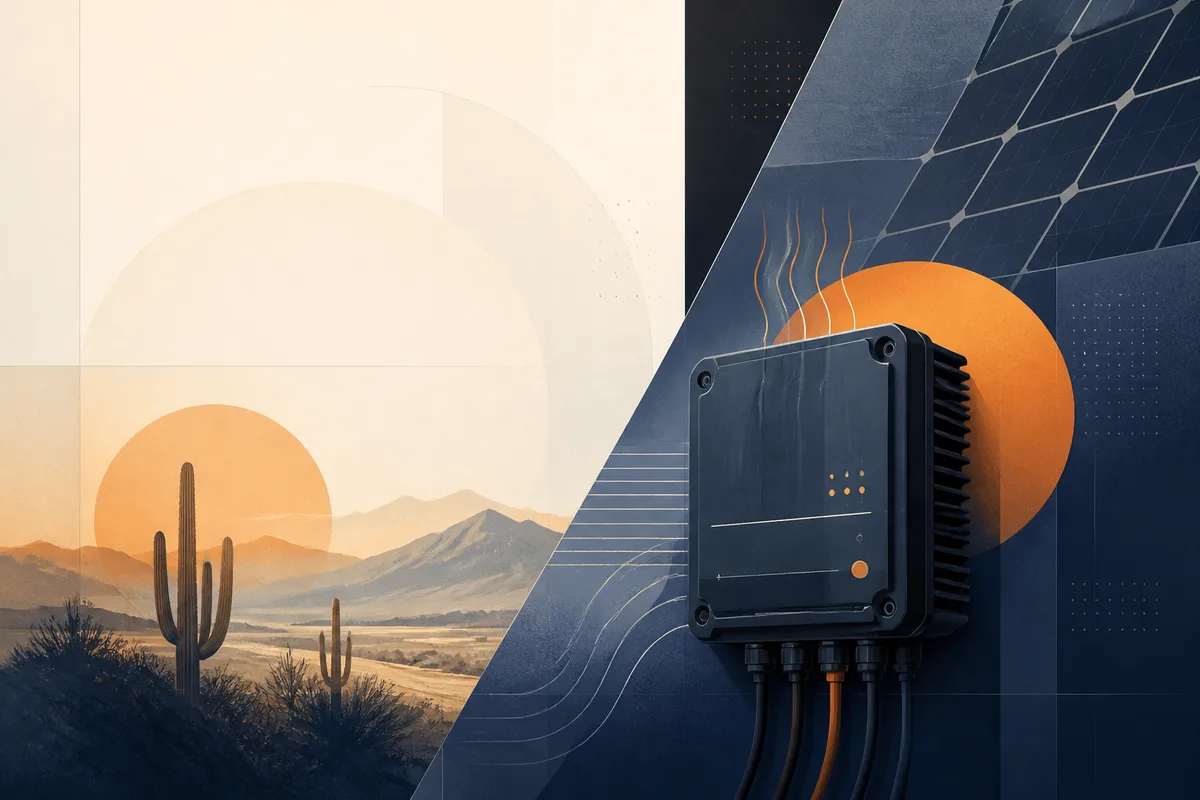
Managing RV Solar Charge Controller Thermal Throttling in the Sonoran Desert
In the peak of the Arizona summer, RV owners often witness a counterintuitive failure: as the sun gets stronger, the charging amperage drops. This isn't usually a failure of the solar panels themselves, but rather the charge controller protecting its internal circuitry. When an enclosure reaches its thermal limit, the device throttles incoming voltage to reduce heat generation, leaving your batteries stagnant while the sun is at its zenith.
This guide breaks down the mechanics of heat-induced electrical resistance and provides a diagnostic framework for identifying whether your controller is malfunctioning or simply surviving. It is designed for full-time travelers and seasonal residents who rely on off-grid power in environments where exterior temperatures routinely reach levels that exceed standard consumer electronics ratings.
Why desert heat triggers solar charging failures
Standard electrical components are rated for performance at room temperature, but an RV storage compartment in the desert can easily exceed those ratings. Heat changes the physics of your power system in several specific ways:
- Increased internal resistance in copper wiring forces the controller to work harder to push current, generating more waste heat.
- Lithium battery thermal protection circuits may disconnect the charging path entirely if the battery cells exceed their safe operating temperature.
- Pulse Width Modulation (PWM) controllers lose significantly more efficiency to heat compared to Maximum Power Point Tracking (MPPT) units.
- Thermal expansion and contraction cycles can loosen terminal screws, creating "hot spots" that trigger early shutdown codes.
The diagnostic playbook for high-heat solar failure
1Verify the thermal derating state
Check the display or Bluetooth app for a "Current Limiting" or "Over-Temp" status code. Most modern controllers will not shut off entirely; they will instead cap the output at a fraction of their rated capacity to prevent internal damage. If the amperage drops exactly as the sun hits its peak, the unit is likely throttling due to ambient heat rather than a component failure.
2Inspect for physical heat damage
Open the compartment and look for signs of localized overheating at the wire entries. As suggested in the Renogy Troubleshooting Guide, inspect the battery fuse, disconnect, terminal screws, and cable ends for damage. In the Phoenix RV Repair market, these issues are frequently exacerbated by dust accumulation on heat sinks, which acts as an insulator.
3Measure voltage drop at the terminals
Use a multimeter to compare the voltage at the controller’s output terminals versus the voltage at the battery posts. A significant discrepancy suggests that heat has increased resistance in the cabling or that a fuse holder is beginning to fail. High-heat environments demand thicker gauge wiring than what is typically installed at the factory to compensate for this seasonal resistance.
4Evaluate the battery temperature sensor
Most high-end systems use a remote temperature probe attached to the battery bank. If this sensor is faulty or placed in a stagnant air pocket, it may report an "over-temperature" condition to the controller, even if the batteries are safe. Ensure the sensor is firmly attached to the negative terminal or the side of the battery case as specified by the manufacturer.
The impact of MPPT vs PWM heat efficiency
The choice between MPPT and PWM technology becomes a matter of survival in high-temperature zones. A PWM controller essentially acts as a switch, and when it resists the higher voltage of a solar panel to match the battery, that energy is dissipated as heat directly within the unit. In contrast, an MPPT controller uses a DC-to-DC transformer to convert excess voltage into additional amperage.
While MPPT units are more efficient, they also contain more complex internal components that are sensitive to the environment. If an MPPT unit is mounted in a small, unvented cabinet, it will reach its thermal ceiling faster than a simpler PWM unit. For those experiencing rv battery not charging in sun scenarios, the solution is often relocating the controller to a space with active ventilation or adding a dedicated 12V cooling fan to the heat sink.
Professional Maintenance and Standards
Addressing solar failures in the desert requires a holistic look at the electrical system, from the roof-mounted panels to the battery bank. A professional assessment typically involves a full thermal scan of the electrical bay to identify high-resistance points. This often coincides with an inspection of the RV Roof Repair & Resealing to ensure that cable entry points remain watertight and that solar mounts haven't compromised the roof membrane. Technicians verify that all installations are secure, checking fuses, circuit breakers, and potential PV module issues as recommended by Victron Energy.
Frequently asked questions
Why does my solar controller work in the morning but stop at noon?
This is a common symptom of thermal throttling. As the sun reaches its peak, the controller processes its maximum current, generating internal heat. Simultaneously, the ambient temperature in your RV's storage bay rises. Once the internal sensors hit a threshold, the device reduces power output to protect its transistors from failing.
Can I spray my solar panels with water to improve charging?
While cooling the panels can temporarily increase their voltage output, it is not a recommended long-term solution. In high-heat areas, the high mineral content in the water can leave "hard water" spots that permanently shade the cells and reduce efficiency. Furthermore, spraying cold water on glass that has been sitting in extreme heat can cause thermal shock.
Is it safe to leave my RV solar system on during summer storage?
Yes, provided the charge controller is functioning correctly and the batteries are not in a confined space without ventilation. However, you should ensure the controller is programmed for the correct battery type. As noted by Zamp Solar, if an RV has a solar side wall port, owners should check for missing or blown fuses or unattached wiring at the battery bank.
How do I know if my lithium battery thermal protection is active?
Most lithium (LiFePO4) batteries have an internal Battery Management System (BMS) that stops charging if the internal temperature exceeds a safe limit. If your solar controller shows voltage but zero amps are entering the battery, the BMS has likely opened the circuit to prevent damage. You will need to wait for the battery temperature to drop before it will accept a charge again.
Does dust on the solar panels cause controller errors?
Dust generally causes a decrease in total power production. However, as noted in the Victron Energy Troubleshooting Guide, very dirty PV modules can impact system performance. Keeping panels clean is essential, but most "error" codes are generated by electronics issues such as overvoltage or faulty circuit breakers.
What is the best way to cool down an overheating controller?
The most effective method is increasing airflow. If your controller is mounted inside a cabinet, you can install a small 12V fan that triggers when the solar panels are producing power. Alternatively, mounting the controller on spacers so there is a gap between the unit and the wall can allow air to circulate behind the heat sink. Residents in the Phoenix area should call (623) 246-7620 for assistance with solar system optimization.
What happens when you get in touch: you describe the situation, we ask the few questions that actually change the answer, and you get a clear scope and next step — no obligation.